─── ⋆⋅☆⋅⋆ ───
Disclaimer / Terms of Fiction:
This text is a work of fiction in the sci-fi and dystopian genres. All events, characters, organizations, laws, referendums, and "scientific discoveries" described herein are entirely products of the author's imagination. Any resemblance to actual historical figures, living or deceased persons, or existing religious and state institutions is purely coincidental. The author does not intend to offend anyone's beliefs, spread misinformation, or express any political views. This is simply a dark tale about the end of the Universe.
─── ⋆⋅☆⋅⋆ ───
Chapter 1. The Smirnov Effect
The morning turned out to be freezing: minus fifteen degrees Celsius in early October. The closed research town of Horizon-57 was covered in frost, and frozen puddles crunched beneath the heels of a few passersby rushing about their business. Pavel took a deep breath of the icy air. “Finally,” he thought. The long-awaited winter. The midges that swarmed in clouds around these parts completely ruined any affection for the local summer.
Stepping away from the porch, he lit a cigarette. He had been planning to quit for a long time but could never find the courage.
“Next month, for sure,” he said softly to himself.
Pavel set off for work on foot—walking in such air was pleasant. He walked slowly down the street, which was illuminated by lanterns. The frost beneath their beams sparkled and shimmered with all the colors of the rainbow.
“Rainbow,” Pavel remembered. When was the last time he had seen one? Probably back in his childhood. Since then, there had simply been no time to look at the sky—you were constantly staring at a monitor. He smiled wryly. That was probably why it was so pleasant now to see at least these tiny sparks in the frozen puddles. Fifteen minutes later, he was already standing at the security gate of his facility—RIC 23.5.
Research Institute Complex 23.5. Why it was named exactly “twenty-three and five,” no one really knew. The younger staff thought it was all about the length of the underground collider ring—just around twenty-three kilometers. But among the old-timers and maintenance staff, completely different, salty rumors circulated about the chief design engineer and his legendary 23.5 centimeters.
The territory of the RIC was brightly lit along its entire perimeter. A few low-slung buildings, connected by covered glass walkways, resembled an intricate snowflake from above. Painted in the tricolor flag—everything as it should be.
He passed through the security airlock—painfully familiar; over the recent years, Pavel had memorized every scratch in there. Thousands of hours in a closed space, yet he sincerely loved what he did. Pavel monitored the data streams flowing continuously from the underground detectors. If a cable came loose or a board overheated on any layer of the gigantic underground machine, a warning yellow sector would instantly light up on his monitor.
Before each run, he performed a calibration: running test signals to check the accuracy of the sensors. But his main responsibility was managing the “filtering.” Pavel literally decided which physics was “correct” and which was not. He wrote algorithms for neural network filters that discarded tons of background digital garbage: interference from power cables, echoes of underground micro-tremors, and tracks of cosmic rays piercing the planet right through.
And today, he had to debug and configure another node—the calorimeter of the forward detector. This sensor was a cyclopean, multi-layered cylinder buried deep underground at the beam collision point. Inside it, ultra-thin plates of super-dense tungsten alternated with layers of liquid argon, threaded with thousands of silicon filaments.
The device's task was simple but precise: when a particle flew through it, it crashed into the tungsten, producing a cascade of micro-flashes, and the silicon filaments instantly read their energy and trajectory. For the computer, these were just billions of digits per second, and it was up to Pavel to tune the AI filter so the device wouldn't go blind from its own noise.
Pavel poured himself a mug of strong coffee, sat back in a deep operator's chair, and brought up the calorimeter interface on the main screen. The shift had begun.
Deep underground, in a massive concrete hall right next to the calorimeter, worked Maxim Sergeyevich, a maintenance electrician. He was a heavy, elderly man with severe shortness of breath. Today, he was conducting a routine inspection of the high-voltage power buses for the superconducting magnets—checking for any liquid helium leaks from the cryogenic cooling loops.
Suddenly, Maxim Sergeyevich felt a strange, leaden heaviness in his chest. He froze for a moment, gasping for the cold, ozone-scented underground air, trying to quell the crushing sensation behind his breastbone. Suddenly, a sharp, unbearable pain pierced his heart.
Maxim Sergeyevich tried with trembling, instantly numb fingers to pull a blister pack of pills from the breast pocket of his blue work overalls. But the plastic packaging slipped from his hands. The pills scattered and fell down with a dry clatter, dropping through the slots in the metal mesh walkway of the technical bridge.
The man twisted in pain. Losing consciousness, he collapsed to his knees and then tumbled onto his side, convulsing in his final moments.
At that exact same nanosecond upstairs, in the warm and quiet Control Room, Pavel, who was calibrating the sensors, nearly spilled his coffee. One of the calorimeter sectors on the main screen flared crimson. The trigger system choked on the influx of data. The monitor threw a system error: the detectors had recorded a wild, absolutely impossible spike of energy—1016 eV.
From an empty point in space where there was no proton beam at all.
Not believing his eyes, Pavel frantically pounded the keyboard. His heart hammered somewhere in his throat. He forced a re-check of the readings three times. The silicon filaments were not lying. There was no instrument error. Inside the underground hall, something had occurred that was comparable in power to a supernova explosion.
With a trembling hand, Pavel pulled up the feed from a security camera located near the malfunctioning sensor onto an auxiliary monitor. The screen showed the dimly lit space of the lower tier. There, on the metal mesh walkway, right beneath the cable trays, lay a motionless man in blue overalls.
Chapter 2. Torture by Bureaucracy and a Digitized Miracle
Pavel sat in the stuffy office of the safety inspector, recounting the chronology of events for the twentieth time. The inspector—a lean, wiry man with an inquisitive gaze and a sharp, hawk-like nose—asked the same questions monotonically, like an automaton. Over and over. The necessity of writing endless explanations by hand amidst a pile of departmental paper bureaucracy was driving Pavel out of his mind, but he held on, gritting his teeth.
An emergency like this had happened at RIC 23.5 for the first time. An elderly electrician simply had no right to die right on top of the detector, violating all safety protocols. And now the inspector was determined to find out what exactly this unfortunate Maxim Sergeyevich had messed up before his death that caused the vaunted, incredibly expensive calorimeter sensors to go haywire and trigger a system crash.
The inspector was certain the old man had caused a banal short circuit. And only Pavel, looking at the form lying before him, understood: no short circuit in the world could produce ten to the sixteenth power electronvolts.
The torture by bureaucracy lasted until two o'clock in the morning. Only then was Pavel finally released, and he headed to his company-assigned apartment. He no longer had his own housing—"thanks" to the efforts of his ex-wife's lawyer.
On the way home, he didn't look around at anything. His only desire was to fall into bed as quickly as possible and pass out. It felt like he hadn't even closed his eyes when he was awakened by the arrogant, mocking ring of an antique alarm clock. Ironically, it was the only valuable piece of property left to him after the divorce.
Half past six in the morning. Outside the window lay pitch-black darkness—as always in Siberia at this time of year. Breakfast consisted of quickly scrambled eggs and a tasteless 3-in-1 instant coffee.
Time to go to work.
“Well, let's figure out what actually happened there,” Pavel muttered gloomily to himself, putting on his shoes in the hallway.
Pavel dove deep into the logs and raw sensor data. It didn't look like a short circuit, a system glitch, or anything he had ever seen before. Based on the three-dimensional trajectory of the particle dispersion, it appeared that the fan of micro-flashes started exactly from the geometric center of the spot where the worker had passed away.
“Strange,” Pavel thought, nervously tapping his fingers on the table. “Damn strange. Did something... fly out of him?”
A soul.
Pavel immediately slapped himself mentally: “Alright, stop. Don't invent bullshit. What soul? You're a nuclear physicist, not a priest.”
But the numbers on the screen stubbornly insisted. The decay was spherical. The particle dispersion vectors indicated that the energy source was located inside Maxim Sergeyevich’s chest cavity.
“What if I check it?” a wild thought flashed. At the beginning of the century before last, some American doctor had already tried to weigh the souls of the dying. Ha, well, of course, he didn't weigh anything; those famous "21 grams" turned out to be ordinary moisture loss during exhalation and post-mortem muscle relaxation.
“I'm going in the completely wrong direction,” Pavel rubbed his bloodshot eyes. “But on the other hand... the scientific method requires testing any hypothesis, even the craziest ones. If this was a local quantum breakdown of the calorimeter itself, then portable devices in a different location will show nothing. But if...”
There was a portable scintillation detector in the laboratory. Of course, no one would just hand over a piece of equipment worth as much as a good foreign car from the warehouse, but Pavel was friends with the guys from the radiation control department—that issue could be resolved. The energy of yesterday's flash was colossal; if something similar happened again, the heavy, military-grade portable sensor would detect it even through a wall.
“Ha. I've definitely lost my mind if I'm seriously planning this,” he chuckled. But his hand was already reaching for the internal phone to dial a familiar reanimatologist at the Horizon-57 city hospital.
The portable detector was secretly installed by the bed of a hopeless patient connected to a life support system. It was done with the heavy, tearful permission of his wife. The unfortunate young man had been in a coma for six months after a horrific accident, while doctors held onto some shred of hope and instruments caught faint, fading signs of brain activity.
But in recent days, the medical board had pronounced brain death. There was no more hope.
His wife, choking back tears, pressed the switch with a trembling hand, turning off the ventilator. Pavel held his breath, keeping his eyes glued to the screen of the portable scintillator. A heavy, ringing silence hung in the room, broken only by the quiet, steady beep of the heart monitor, which rapidly turned into a single, continuous, endless tone.
At the exact moment the unfortunate man's heart stopped beating, Pavel's eyes nearly popped out of his head.
The screen of the portable device flashed frantically. Cascades of numbers rushed across the gray matrix, recording the already familiar, colossal release of energy. The exact same spherical micro-explosion that could not be ignored or dismissed as a collider error. The energy tore through the space of the ward, causing the instrument needles to go wild for a fraction of a second.
The soul existed. Physically, tangibly, in the hard readings of quantum sensors.
Subsequently, this phenomenon—a post-mortem quantum burst of high-energy particles—would be named the “Smirnov Effect” in scientific papers. Named after that very same simple electrician, Maxim Sergeyevich Smirnov, who died on the underground walkway of RIC 23.5 and was the first to leave his parting trace on the tungsten plates of the detector.
Pavel stared at the flashing screen, his mind racing: what on earth was this? Why hadn't science recorded anything like this before? Why exactly now?
There were too many questions. A soul? No way, nonsense. But if he were a religious man, that's exactly what he would think. Was it worth making this public?
However, no one was asking his opinion anymore.
The complex's security service reacted instantly. For unauthorized use of portable equipment and illegal entry into the hospital, Pavel was severely taken into custody. For an entire week, he sat under arrest in a closed detention facility of the Ministry of Internal Forces, answering the endless questions of men in plain clothes. All data from the scintillator was confiscated, wiped from local media, and sent somewhere to the very top under the classification "Top Secret."
A week later, Pavel was just as suddenly released. They offered a dry apology and transferred a colossal bonus equivalent to forty months' salary to his account.
The General Director of RIC 23.5, Matvey Vladimirovich Shirtz—a heavy-set man with perpetually tired eyes—personally called him into his office.
“Pack your bags, Pasha,” Shirtz said quietly, without looking at him, as he signed some papers. “You are going to Moscow, to the Central Research Institute.”
“But, Matvey Vladimirovich, what's out there...”
“Don't ask anything,” the director interrupted sharply, finally raising a heavy gaze. “I don't know anything myself. And frankly, I don't want to know. Your flight is in an hour. The car is at the entrance.”
Chapter 3. A Visit to the Bishop
Moscow greeted Pavel with a dreary, drizzling cold rain. Right on the runway of the government terminal, a special transport vehicle awaited him, which, without any explanation, took Pavel to a suburban restricted hospital. There, for a week, he was scanned and checked inside out using the latest medical tomographs, undergoing endless tests and reflex evaluations.
Scientists in sealed white overalls behaved distantly—it seemed they were desperately trying to find a quantum anomaly within him. As if the "Smirnov Effect" could be contagious.
Finally, when the medics were satisfied that Pavel was clean, he was transferred to the very center of the capital and checked into the Grand Hotel National—right opposite Manezhnaya Square and the Kremlin. The crimson government towers were perfectly visible from the huge panoramic windows of his suite. That same evening, a silent handler from the ministry briefly explained Pavel's task: a car would pick him up tomorrow morning. He was to meet a very influential person.
In the morning, Pavel was driven to a highly guarded mansion in one of the quiet alleys of old Moscow. After numerous and humiliating security checks at several checkpoints, he was finally led into a spacious office, seated in an expensive leather chair, and told to wait.
Rustling the folds of an expensive cassock, Bishop Silouan Maloselsky, vicar to the Holy Patriarch, sat in the chair opposite him. He looked at Pavel intently, scrutinizingly, and asked softly:
“You do know, Pavel, that in the past, scientists were burned at the stake by the Inquisition for certain discoveries? All because their discoveries contradicted Church dogmas. But your case is diametrically opposed. Not a single scientist in human history has ever confirmed the tenets of faith regarding the immortality of the soul using formulas and graphs.”
The vicar paused, allowing Pavel to realize the weight of those words.
“You have accomplished the impossible, young man. You have digitized a miracle. And now, you and I need to decide what to do with all this.”
“Silouan... can I call you that?” Pavel inquired, trying to manage his agitation.
“Call me 'Father',” he replied.
“I... I didn't mean to do any of this. It was just an equipment check...”
“But you did it anyway,” Silouan interrupted softly but firmly.
“I just wanted to understand what happened on the walkway. And I don't believe in the soul or in God.”
“A pity,” the vicar smiled subtly. “The party line requires us to strengthen and develop faith among the people. And you, young man, with your discovery, have struck gold.”
Pavel stared blankly at the patriarch's assistant.
“You will now become our new saint, Pavel. Even if you really don't want to,” the vicar leaned forward, his gaze turning to steel. “Right now, we vitally need real, scientifically proven miracles. And you, with your soul energies, arrived just in time. Everything has already been checked and double-checked,” Silouan continued softly. “Nothing special is required of you anymore. Just attend services occasionally, and, of course, we will grant you a high-ranking position within the government.”
Pavel frowned: “Excuse me, Father, which services exactly do you mean?”
“What do you mean, which ones?” the clergyman looked genuinely surprised. “Church services, of course. Easter, Christmas, and occasionally on major holidays. Let the people see on television that advanced science is not devoid of faith.”
“No,” Pavel cut him off, standing up from his seat. “Do whatever you want with me, put me back in a cell, but I will not participate in this.”
The vicar didn't even bat an eye at this outburst. He merely smiled condescendingly:
“Well, if it's a no, then it's a no. We don't force anyone, it's your choice. I hope you realize what you are turning down right now? Many in your position would give half their lives for such a post and the privileges that come with it. But as I see it, you are a man of principle and ideology. So I won't compel you. It was merely my personal initiative. Since you refuse—well, all the best.”
Silouan stood up and, paying not the slightest attention to Pavel anymore, silently walked out of the office.
Chapter 4. The New Reality
The company apartment in the town of Horizon-57, on Chkalov Street, greeted its owner with silence and gloom. A dull light from a yellow streetlamp pierced through the curtained window. On the table was an ashtray, a TV remote. In the sink, dirty dishes had been waiting for their hour for four days now. The persistent smell of tobacco permeated the entire space.
Pavel sat on a chair, lit a cigarette, and stared into the turned-off television, lost in his thoughts. His thoughts slowly shifted from one to another without focusing on anything specific. He simply allowed his brain to relax, thinking about nothing. It became a little easier.
He decided to take a walk outside—it was already nearly minus twenty. The first snow was slowly falling onto the black asphalt of the streets, the roofs of houses, and the frozen flowerbeds. He wandered aimlessly along the sidewalk, past shop windows and evening cafes. Through the glass, he could see people buying things, having dinner, and chatting. The city lights, which had once seemed pleasant to Pavel, now felt like an inappropriate garland at a funeral. A vile, lingering melancholy washed over him.
A sense of approaching doom. Pavel decided it was best to sleep it off—by morning, it would pass.
Sleep helped him fully recover: in the morning, Pavel felt rested and less burdened. But at work, a surprise awaited him in the form of an assigned "escort" from the security department. A sullen man in plain clothes now followed him relentlessly, not leaving Pavel for a single minute. Except for when he was alone in the restroom, and even then, only temporarily.
Days dragged after days. A succession of endless, monotonous workdays began again in Pavel's life. At home, everything remained as before. He would arrive, eat the leftovers from breakfast, and watch some garbage on the tube to unwind.
Lately, fierce battles had been breaking out on TV talk shows regarding the Smirnov Effect, which was said to have been discovered "in secret laboratories."
“Well, at least there's that. Better they call it the Smirnov Effect than soul energy,” Pavel thought to himself, watching the opponents clash to the death, foaming at the mouth to prove their points. One argued for the scientific basis of the phenomenon but was clearly losing to an adversary clad in a black cassock. The latter proclaimed the truth about the "divine spark" and the Almighty's plan, which had now supposedly been proven by science.
“Sure, sure,” Pavel thought. “No one has proven anything yet. But there is a correct interpretation, and it suits certain people at the top very well. Which means they will soon declare it the only true one.”
Half a year passed. Spring reminded everyone of its presence with a cheerful dripping of melting icicles. The sun began to warm things up, and the snowdrifts turned a dirty gray, preparing for their swift and inevitable disappearance. Nature was coming alive.
Next Sunday was the unified voting day, featuring a referendum on recognizing Christianity as the state religion and integrating the church into the state apparatus. The Ministry of Education was already busy training specialists in theology: it had been recognized as an exact science alongside physics and mathematics. Now it would be taught on equal footing with them.
“Well, how about that,” Pavel thought. “How fast everything happens for them.”
And people would vote for it. Lately, the number of believers had grown so much that churches were bursting with people wanting to take communion. Even within his RIC 23.5, a place had appeared where one could pray and light a candle. Several times, Pavel noticed the local cleaning lady, Baba Tanya, secretly crossing him in the back.
After the votes were counted, it was announced that the people had voted "yes": 73% against 27%. In total, 62% of eligible voters turned up at the polling stations.
“Well, essentially, this is just a confirmation of an already accomplished fact,” Pavel thought, finishing his cold scrambled eggs.
Another news item caught his attention. It was reported that physicists in Brazil, specializing in the study of the Smirnov Effect, had recorded a drop in the flash energy. Up until this very moment, its strength had been considered an absolute constant.
Now that was truly significant, frightening news.
Chapter 5. A Foreboding of the Inevitable
Pavel spent all his free time online, gathering data bit by bit. He contacted his Brazilian colleagues directly—they had no secrets from the scientific community and freely uploaded their research into the public domain. The flash energy was indeed falling. What was causing this, no one understood.
Furthermore, no one had yet presented a coherent explanation for the mechanism of the Smirnov Effect itself: theories collapsed one after another, not a single model could explain this phenomenon, let alone the progressive decay of its energy. According to the Brazilians' calculations, in just ten years, the energy of the post-mortem flash would drop to zero.
Ominous rumors immediately began spreading across the network. Ordinary citizens and preachers flooding the internet shouted in unison that the energy was melting away due to human sins. And when it hit zero, the divine spark would finally extinguish, and the end of the world would come.
Pavel chuckled: “Maybe it never existed at all, your divine spark. Besides, when it vanishes completely, they'll invent something new. Or maybe they will deny its disappearance altogether, stubbornly insisting that everything is fine.”
Time passed. The country was preparing to welcome yet another New Year—the year 2157. Pavel spent December thirty-first at home in solitude. The same smoke-filled bachelor apartment. He didn't cook anything, just went to bed early.
On the first of the month, waking up refreshed and well-rested, he turned on the television while shaving in front of the mirror. The news anchor was reporting on how the country had celebrated the holiday. There was a noted trend among progressive youth of abandoning New Year's celebrations in favor of celebrating Christmas.
“Young people,” the anchor intoned, “prefer Christmas over the New Year. According to VCIOM polls, about 67% of respondents rejected the old holiday. That is 32% more than last year.”
“Right, right,” Pavel thought. “Of course.”
Then came news of art and showbiz, and almost casually, the host mentioned that scientists had detected the spontaneous decay of a proton. Without dwelling on it, the anchor handed over to a young woman who transitioned to the weather forecast.
Pavel didn't immediately process what he had just heard. He was occupied with thoughts of his ex-wife and how they used to spend the holidays together. He thought he had misheard. “I'm just not awake yet,” he decided, “imagining things.”
Finishing his morning routine, he put yesterday's dumplings into the microwave to heat up and turned the TV back on to wait for the broadcast repeat and check what the anchor had blurted out about the proton.
The anchor dutifully repeated: at CERN, a spontaneous proton decay had been detected; an equipment check was underway. Apparently, errors had arisen in the interpretation of sensor readings.
“Holy crap, quite the errors you've got there,” Pavel spoke aloud. “They must have been celebrating the New Year too and spilled beer somewhere important to get a reading like that? There's your civilized Europe—they broke an incredibly expensive instrument.”
He smiled bitterly.
Suddenly, the phone rang.
“Who else hasn't slept it off and is calling random numbers?” Pavel grumbled.
Glancing at the display, he froze: “Matvey Vladimirovich Shirtz.”
“Well, the boss. What could he possibly want at a time like this? Is he actually trying to congratulate me?” Pavel thought.
But Matvey Vladimirovich started without any pleasantries:
“Pavel, get to the lab immediately! I'll explain everything on site.”
Leaving his unfinished breakfast, Pavel rushed to his RIC 23.5. Shirtz met him right at the security gate. The director looked absolutely awful: a gaunt face, a wild look in his eyes.
“Hello, Pasha,” he said hollowly instead of a greeting.
“Did you hear the news from CERN?” Pavel asked immediately, trying to suppress his rising anxiety. “Something must have broken over there, probably...”
“Don't fool yourself, Pasha,” Shirtz interrupted him, his voice trembling. “Nothing broke over there. Everything is operating normally. That's the whole point! Our calorimeter recorded the exact same thing an hour ago.”
The remaining hair on Pavel's head stood on end.
Chapter 6. The Crumbles of Constants
They proceeded to the Main Control Room. On the massive central monitor, the fresh particle tracks and their colossal energy were clearly visible.
“Something has fundamentally changed,” Shirtz said quietly.
“I think so,” Pavel replied, not taking his eyes off the screen. “Could it be the very thing I'm thinking of?..”
“Nothing can be stated for certain right now,” the director answered hollowly.
At that moment, Shirtz's phone rang intensely. On the other end of the line, someone began reporting something breathlessly, speaking in a rapid clip. Matvey Vladimirovich stepped aside, leaving Pavel alone with the display, frantically digesting what was currently happening to the planet's physical laws.
Finishing the conversation, Shirtz collapsed heavily into a chair, looking like a man completely crushed and destroyed by grief.
“Do you know what they're reporting?” he uttered barely audibly. “Laboratories all over the world have begun registering the same thing.”
“So... it really is decay?” Pavel voiced his most terrifying verdict aloud.
“Yes. And apparently, your Smirnov Effect was just a precursor. The first symptoms... You know, Pasha, why don't you go home. Get some rest. Look at the sun, breathe the air one last time...”
Shirtz wanted to say something else, but suddenly cut himself off. His face instantly contorted with fierce pain; he frantically grabbed his chest with his hand and slumped back into the operator's chair.
The ambulance that arrived twenty minutes later could only pronounce him dead.
Pavel wandered aimlessly around the town until he was frozen through—minus thirty in Siberia is no joke. Arriving home completely hollowed out, he simply collapsed onto the bed exactly as he was, in his outdoor clothes, and passed out instantly.
He woke up because a bright, unnaturally dense beam of sunlight was hitting his face. Glancing at the alarm clock, Pavel realized that yesterday he had forgotten to wind its antique spring mechanism. The clock had stopped.
“I still exist, and that can't help but be pleasing,” he thought detachedly. He reached for the remote and turned the television to a news channel.
“Financial markets have plummeted by two hundred points instantly!” the anchor reported breathlessly. “An unprecedented economic collapse is unfolding worldwide against the backdrop of the latest news. Mass riots and clashes with police have erupted in Melbourne, Paris, and Sydney... Religious leaders of all denominations urge their congregations to maintain calm, not to fall into despair, and to pray diligently for salvation!”
“Sure, pray, of course,” Pavel muttered aloud, looking at the screen. “That's really going to help us all a lot, yeah. Just ring the bells louder—their holy vibrations will definitely stop proton decay.”
He giggled nervously, hysterically.
The anchor, meanwhile, continued, trying his best to keep his composure:
“A widespread increase in background radiation has also been recorded, however, at the moment, it still does not exceed established norms...”
“Well, norms are a flexible thing,” Pavel advised the screen. “They can always be adjusted on paper, and they'll become normal again.”
Chapter 7. A Junior Suite of a Brown Sky
Pavel walked to the nearest shop.
In the 24-hour convenience store, the cashier girl and an old security guard—a lean, gray-haired man of about fifty—were discussing something. Seeing him, they fell silent. The girl asked, “What do you need?”
Pavel pointed to the cognac. She handed over a bottle. Pavel said, “Give me a case.”
The cashier, not surprised in the least, put the bottle back and pulled out a box. Pavel paid.
Just as he was leaving, she asked him, “You work at the RIC, don't you? What are they saying about this over there?”
Pavel turned around and replied, “Nothing good. I won't lie to you—everything is completely screwed.”
He headed home. He met only a couple of people on the street—the town seemed deserted. “Probably everyone left to be with their families,” he thought detachedly.
Having boiled some store-bought, terrible dumplings, Pavel polished off an entire bottle by himself to accompany them and went into a deep knockout.
The morning began with gulps of cold water tasting of chlorine and rust straight from the tap. Pavel listened to the news—well, they were still broadcasting, and that was a definite plus. The anchor, clearly generated by a neural network, recounted the total collapse of the global financial system cheerfully and with an unvarying, radiant smile on his face.
“Of course, you can't take your cash with you, and you won't buy your way out of decay with it,” Pavel gloated, pressing his lips to the neck of another bottle.
He turned his head and looked out the window. The sky, which had been blue just yesterday, had now acquired a menacing brownish-buff tint. And the sun shone with a strange, sickly greenish cast.
“Oh, a junior suite!” he marveled drunkenly. “Now that I approve of, that's our style. Brown is so very us...”
The anchor, meanwhile, transitioned to the science segment and casually spoke about the shift in spectral lines. Orbital telescopes had recorded the instantaneous disappearance of entire regions of galaxies that had still been visible in the sky just yesterday. The Universe was collapsing like a house of cards.
Pavel turned off the television. The apartment fell silent immediately.
He walked to the window and stared at the brown sky for a long time. Once upon a time, he had dreamed of pursuing grand science. It had seemed to him that physics was mastery over the unknown. If a phenomenon exists, it can be measured. If it can be measured, it can be understood. And if understood, then sooner or later, one can learn to utilize it.
That was how the world worked. At least, in the past.
Now he realized how naive he had been. The Smirnov Effect was not the problem. The drop in its energy was not the problem. Even proton decay was not the problem. Problems get solved. These were symptoms.
When a person runs a fever, a doctor doesn't fight the numbers on the thermometer. The temperature merely reports the illness. The Smirnov Effect was the Universe's temperature. Proton decay was blood in the phlegm. And the brown sky outside the window was the patient's final agonal gasps.
Pavel knew this absolutely for certain. Over the last few days, he had reviewed thousands of pages of reports. Data arrived from all over the world. From colliders. From observatories. From space. All groups independently arrived at the same conclusion.
There was no error. Mathematics left no room for hope. The Universe was dying. Not a country. Not a civilization. Not humanity. The Universe.
He chuckled. All their lives, people had asked scientists how to save the world. No one had ever asked how to save the laws of physics. Because everyone considered them eternal.
Chapter 8. The Final Flash
He woke up at night. Complete darkness and a ringing silence stood all around—there was no more electricity.
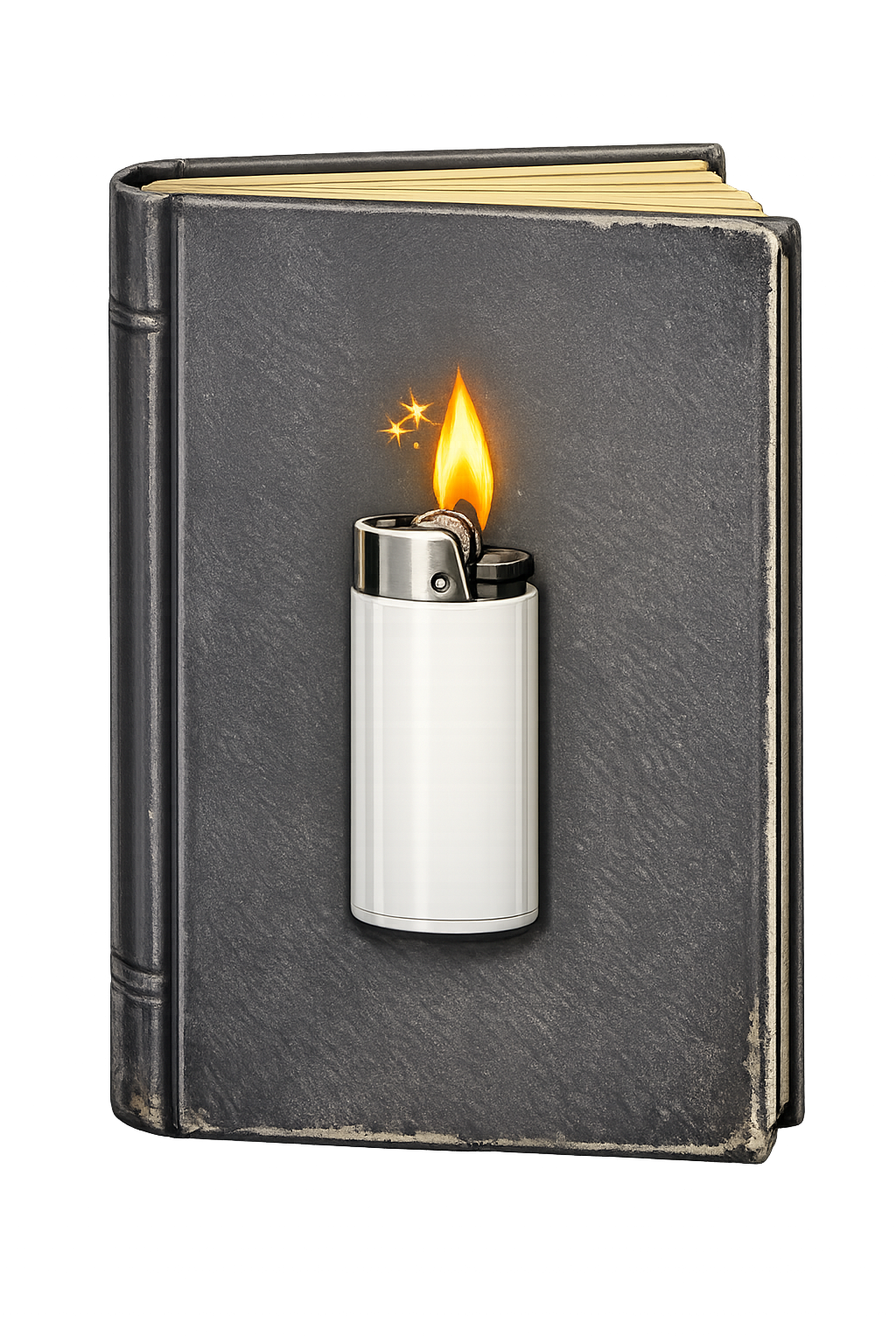
Fumbling around on the nightstand, Pavel tried to turn on his phone, but nothing happened—the screen remained dead. He found a lighter on the table and flicked the wheel, bringing the flame close to the antique alarm clock. The hands had stopped at 2:15. The second hand merely jerked helplessly in place, not daring to step over to the next division.
Pavel looked out the window—beyond the glass reigned a solid, absolute void.
Throwing on his jacket, he stepped out of the apartment. The entranceway met him with a stifling, unnatural soundlessness. No sound at all. And only now, descending the stairs, Pavel realized with horror: he could not hear his own footsteps.
He felt sick—whether from a brutal hangover, primal fear, or everything combined. Stepping out of the building, he tried to discern at least something in this cosmic darkness. His hand automatically flicked the lighter again.
A tiny spark, as if receiving a superpower, instantly spread to the space around it. Pavel managed to notice how this faint light reflected off all surfaces simultaneously.
In that very same nanosecond, absolutely everything around flared up in insane cascades of multicolored lights. Everywhere, the calorimeter of a dying Universe was exploding. And Pavel himself turned into a micro-flash of insane beauty in the blink of an eye, ceasing to exist forever along with the entire planet.
Afterword
The Universe was born at the intersection point of branes—at the moment of their collision within the infinite chaos of hyperspace, an island of expanding, ordered cosmos emerged. However, this expansion itself inexorably thins the structure of order. Over time, first on the periphery and then at the very center, matter loses its stability.
The laws of physics and fundamental constants that seemed unshakeable disintegrate overnight, returning the born space into primal chaos. This cycle is eternal: order is merely a temporary fluctuation in an ocean of the infinite madness of hyperspace.
─── ⋆⋅☆⋅⋆ ───




 июня 16, 2026
// SYSTEM_REVIEWS